Grenada Raises CBI Contribution to $235,000 With Enhanced Screening
Grenada's CBI programme just got 57% more expensive for individual applicants, and the government is framing mandatory in-person interviews as a quality upgrade rather than what it also is: a revenue increase.
What changed
The Grenada Citizenship by Investment Committee has raised the National Transformation Fund (NTF) contribution for single applicants from $150,000 to $235,000. Family applications see proportional increases. The real estate investment route, which requires purchasing approved property worth at least $220,000 (held for a minimum of five years), remains an alternative pathway but has also seen fee adjustments on the government processing side.
The enhanced due diligence measures are the other half of the story. All principal applicants now face mandatory in-person interviews, either at a Grenadian embassy or with approved agents in select cities. Background checks have been expanded to include deeper financial history reviews, social media analysis (yes, really), and cross-referencing against a broader set of international compliance databases beyond the standard World-Check and Dow Jones screening.
Grenada's programme has historically been considered the most selective of the Caribbean CBI options. These changes push that reputation further, though whether selectivity and higher pricing produce better outcomes for the country is a separate question.
The Caribbean CBI pricing landscape
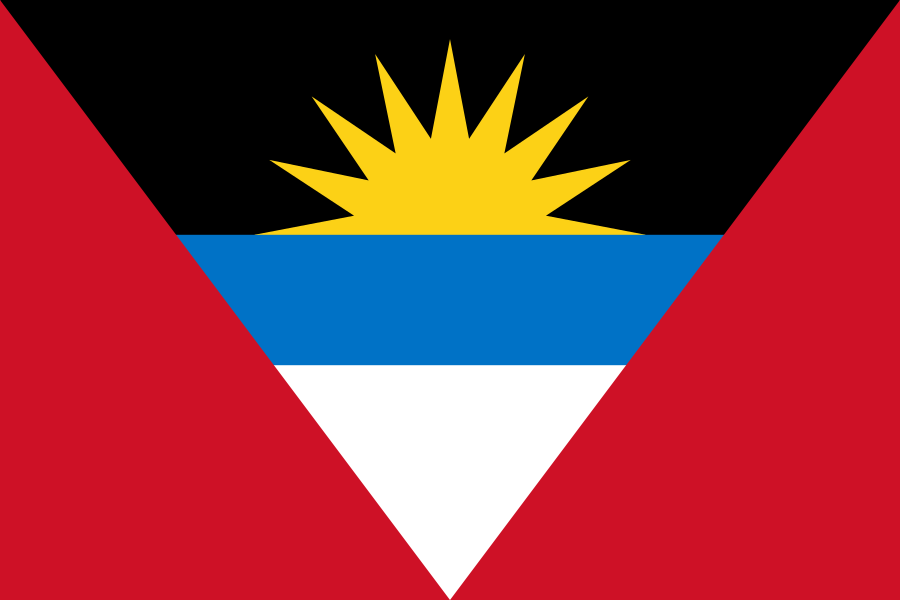
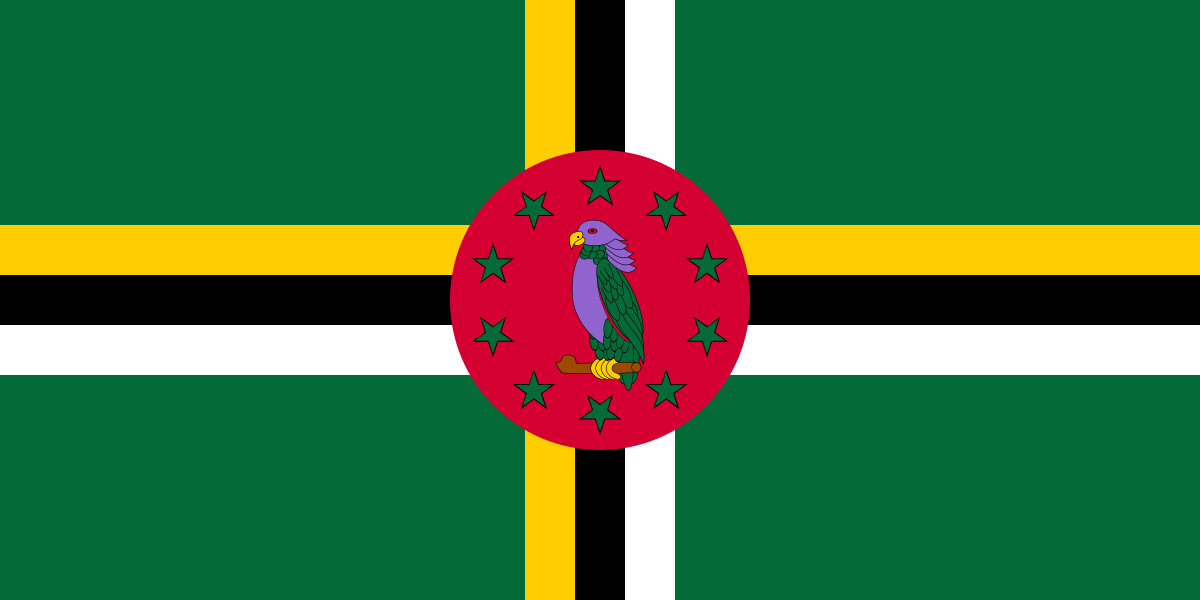
At $235,000, Grenada now sits at the top of the Caribbean CBI pricing scale for donation-route citizenship. Dominica charges $200,000 for its Economic Diversification Fund contribution. St. Kitts and Nevis sets its Sustainable Island State Contribution at $250,000 for the standard option, though it has introduced various promotional pricing at different points. Antigua and Barbuda's National Development Fund contribution sits at $230,000.
The pricing convergence across Caribbean programmes is striking. Five years ago, there was meaningful price differentiation. Today, the donation routes cluster between $200,000 and $250,000. The real estate routes show more variation, but the minimum government fees and due diligence costs have risen across the board.
Grenada's unique selling point has never been price. It is the only Caribbean nation with a treaty relationship with the United States (the E-2 Treaty Investor visa), which allows Grenadian citizens to apply for a US E-2 visa to live and work in America. No other Caribbean CBI passport offers that. For applicants whose primary motivation is US access, the $85,000 price increase is essentially irrelevant. They were choosing Grenada anyway.
Quality upgrade or revenue extraction?
The government's framing is predictable: stronger screening protects the programme's integrity and ensures Grenada's passport maintains its visa-free access to 147 countries (including the UK and Schengen zone). There is truth in this. Caribbean CBI programmes have faced periodic pressure from the EU and US over screening standards, and Grenada's relatively clean track record has helped preserve its visa-free arrangements where other programmes have struggled.
But the timing coincides with a period where Grenada's government needs revenue. Tourism recovered well post-pandemic, but public debt remains elevated and infrastructure spending needs are real. CBI contributions flow directly into the NTF, which funds government projects. A 57% increase in the per-applicant contribution, applied across hundreds of annual applications, produces tens of millions in additional revenue.
The in-person interview requirement adds cost and friction for applicants but also creates a genuine screening touchpoint that paper-based due diligence cannot replicate. Several applicants who passed document-based checks at other Caribbean programmes were later found to have misrepresented their backgrounds. Face-to-face interviews catch inconsistencies that database checks miss. Whether Grenada has the consular infrastructure to process these interviews at scale, across time zones and geographies, is another matter.
Who actually pays $235,000 for Caribbean citizenship
The typical Grenada CBI applicant falls into one of three categories. First: high-net-worth individuals from countries with weak passports (Nigeria, Bangladesh, Pakistan, Egypt, Iran) seeking travel freedom. For someone whose passport provides visa-free access to 40 countries, paying $235,000 for access to 147 is a straightforward calculation.
Second: entrepreneurs and investors specifically targeting US market access through the E-2 treaty. These applicants often have business plans that require physical presence in the United States, and the Grenada-to-E-2 pathway is materially cheaper than an EB-5 investment visa (minimum $800,000) with far shorter processing times.
Third: individuals seeking a Plan B passport for political or economic contingency. This group is price-sensitive in principle but not in practice. When the motivation is personal security, the difference between $150,000 and $235,000 rarely changes the decision.
The applicants Grenada loses at $235,000 are the marginal ones, people for whom the old $150,000 price point was already a stretch. Whether losing those applicants matters depends on volume versus quality trade-offs that the government has clearly made its decision on.
What comes next
The enhanced screening measures take full effect for all new applications immediately. Applicants with pending applications under the old fee structure will be processed at the previous rates, though the enhanced due diligence requirements apply retroactively to anyone who has not yet received approval.
Other Caribbean programmes will be watching Grenada's application volumes closely. If Grenada maintains its numbers despite the price increase (likely, given the E-2 advantage), expect Dominica and Antigua to follow with their own increases within 12 months. The Caribbean CBI market moves in lockstep, and nobody wants to be the cheapest option in a sector where cheap carries reputational risk.
Related Jurisdictions
Related Articles
Montenegro Adopts Citizenship by Investment Law With EUR 450,000 Minimum
Montenegro reopens its CBI program with a EUR 450,000 investment floor plus EUR 200,000 government fee. Applications target northern development zones.
Dominica Raises CBI Contribution Threshold and Tightens Due Diligence
Dominica's CBI program now costs $150,000 for single applicants, up 50% from last year. Enhanced screening includes Interpol checks and in-person interviews.
Vanuatu CBI Program 2026: Updated Requirements and Passport Changes
Vanuatu's citizenship-by-investment program promises a passport in 30-60 days for $130,000. But EU scrutiny and due diligence gaps raise real questions about its future.
Argentina Introduces Citizenship by Investment Program Starting March 2026
Argentina has enacted South America's first citizenship-by-investment program, with applications opening March 2026. Minimum investment starts at $200,000 with citizenship granted within two years.