DAO Legal Wrappers 2026: Where Decentralized Organizations Get Licensed
Without a legal wrapper, a DAO is a general partnership. Every member faces unlimited personal liability. The CFTC's 2022 enforcement against Ooki DAO confirmed that governance tokens do not create a legal shield. Since then, a handful of jurisdictions have passed DAO-specific legislation. The adoption numbers tell you how well it is working: Wyoming's DUNA statute, the most ambitious attempt, has attracted three organizations in 18 months.
Wyoming's experiment
Wyoming was first. The DAO LLC Act took effect July 1, 2021, allowing DAOs to register as limited liability companies. American CryptoFed DAO was the first registered entity. The DUNA statute followed in March 2024, creating a Decentralized Unincorporated Nonprofit Association structure that allows on-chain governance without a mandatory board.
The problems are structural. A Wyoming DAO LLC faces automatic dissolution if no proposal is approved or no action is taken for one year. The smart contract must be publicly disclosed, a privacy concern that conflicts with the culture of many DAOs. Amending the smart contract triggers burdensome compliance requirements. And the fundamental tension: Wyoming state law does not bind federal regulators. The SEC, CFTC, and IRS apply their own frameworks regardless of what Cheyenne says.
Three organizations have adopted DUNA after 18 months: Syndicate, Uniswap (through DUNI), and WYDE. The framework remains untested in court.
The offshore alternatives
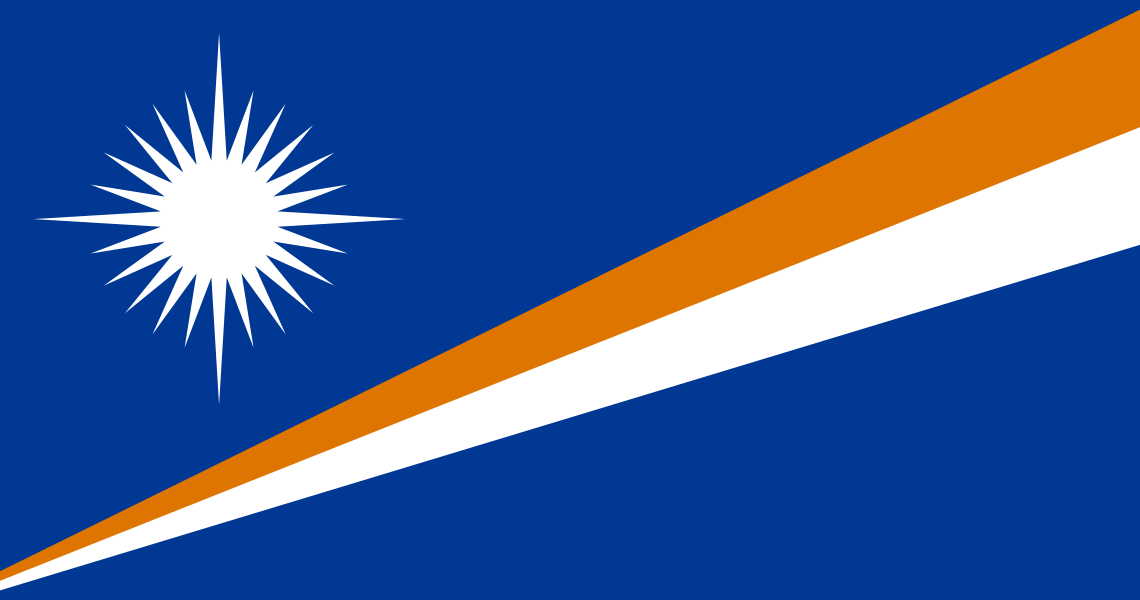
The Marshall Islands passed its DAO Act in December 2022, allowing DAOs to register as for-profit or nonprofit LLCs with bylaws encoded on-chain. Three members required. Members holding more than 10% of governance rights must pass KYC. The legal system mixes English Common Law, US Law, and local statutes, which creates some interpretive flexibility and some interpretive uncertainty.
RAK DAO, part of the UAE's Ras Al Khaimah free zone, launched in October 2024 as the RAK Digital Assets Oasis (DARe). It grants DAOs legal personality within the free zone: the ability to own assets, enter contracts, and open bank accounts. Potential 0% corporate tax on qualifying income. The UAE option is the most commercially practical of the purpose-built frameworks, assuming your members are comfortable with Ras Al Khaimah's regulatory environment.
Switzerland has no dedicated DAO law. The DLT Act of 2021 supports blockchain adoption broadly, and DAOs can structure as Swiss associations or foundations for limited liability. Neither was designed for the purpose, which means legal advisers are fitting square pegs into round holes with reasonable success. The Cayman Islands uses its foundation structure (no DAO-specific legislation). Liechtenstein, BVI, and Panama round out the usual list.
Why adoption is low
The core tension is philosophical. Any legal wrapper introduces centralization: registered agents, compliance officers, KYC requirements, filing deadlines. These are precisely the things many DAO participants organized to avoid. A legal wrapper protects members from liability. It also creates a point of contact for regulators, tax authorities, and plaintiffs.
The Harmony Framework, published in February 2025, proposes a jurisdiction-neutral, modular legal architecture for DAOs. Academic proposals include the DAOLLP model for UK law. Neither has been adopted.
Cross-border enforceability is the practical gap. A Wyoming DAO LLC interacting with users in France, smart contracts deployed on Ethereum, governance tokens traded in Singapore: which jurisdiction's rules apply? No existing framework answers this convincingly.
For DAOs that handle meaningful financial flows (DEX protocols, lending platforms, NFT marketplaces), the legal wrapper is becoming less optional. MiCA's reach, the FATF's owner/operator test for DeFi, and the Ooki DAO precedent all point the same direction. The question is not whether DAOs need legal structure but which imperfect option causes the least friction.
Related Jurisdictions


Related Articles
Company Formation in South Korea 2026: FIPA, Banking, and the D-8 Visa
South Korea allows 100% foreign ownership and processes registrations in about a week. The Foreign Investment Promotion Act makes the pathway clear. The Korean banking system makes everything else complicated.
Company Formation in Ireland 2026: LTD Structure, Substance, and Banking Reality
Ireland's 12.5% corporate tax rate still draws international businesses, but Pillar Two, substance rules, and banking friction tell a more complicated story. What it actually takes to set up and run an Irish LTD in 2026.
Company Formation in Malaysia 2026: Sdn Bhd vs Labuan and the Real Costs
A mainland Sdn Bhd costs under RM 2,000 to register and pays 24% corporate tax. A Labuan company pays 3% on trading profits and 0% on holding income, but substance requirements mean two employees and RM 50,000 in annual expenses. The choice depends on what you are actually doing.
Company Formation in Romania 2026: EU Access at Micro-Enterprise Tax Rates
Romania's 1% micro-enterprise tax on revenue sounds like a headline steal, but the EUR 100K cap, 16% dividend tax, and mandatory employee requirement tell a different story. A practical guide to SRL formation in 2026.